A great video describing a passion for ocean racing that I definately support and understand, it's a short video well worth the quick look...
Saturday, October 26, 2013
Ryan Breymaier Ocean Racing
A great video describing a passion for ocean racing that I definately support and understand, it's a short video well worth the quick look...

Sunday, September 8, 2013
THE EROSION OF YACHTING ETIQUETTE IN THE AEGEAN.
Once upon a time, sailing in the aegean was a relaxing past time that many enjoyed. It was a relatively under exposed vacation style that only those who knew how to sail could enjoy.
The development of the yacht flotilla quickly opened the coast lines of the aegean and especially the Ionian and Saronic Gulfs to groups of yachts following a mother yacht around, like so many ducks and her ducklings. The Flotillas in the early years compromised of about 10 small yachts,each with a nice family on board, all learning how to sail as they ventured from greek island port to the next.
During their week of sailing the lead yacht would endeavour to show people how to better handle there little boats, while also giving them tips on local customs and yachting etiquette.
These where gentler more civilized times , better known as, BC,,,BEFORE COMPUTERS.
In these times asking to raft on to a strangers yacht was normal, helping a damsel down the skinny plank gangway was normal. It was a time when in the morning the skipper would raise with his cup of coffee and sit in the cockpit and chat with his neighbour yacht about the coming days sail and offer advice or hints of places to visit that he had enjoyed....like wise in the evening strangers would enjoy a glass of wine while swapping sea stories or exchanges about the weather...
As the years came and went, flotillas became larger and more complex. The yachts became bigger, gone where the small Snapdragon 27 and the Mirage29, hello to the Bavara36, then
40 and recently seen in flotilla mode Hanse 54 and Sun Odyessy 54.... Gone where the highly personnel and professional companies like YCA and SYC. Now Sunsail and Moorings ran fleets, in fact it has become such a big business that currently in the Saronic gulf area there are no less than 10 companies running flotillas in some sort of disguise. You may say to your self how do they do it and not trip over themselves, well they do and the result can be very ugly.
With so many groups jostling all for the same space in harbours, it has become an issue of first come first moors, otherwise the lonely flotilla leader has to do some very imaginative mooring arrangements. Which will inevitably end up with some sacrifice to the yachting etiquette gods.... Crossed Anchor Chains....extremely tight mooring side to side....ending up with a possible raft on to your yacht of 3 other yachts and a non stop traffic of people crossing your yacht though the cockpit, forward of the mast..all with their shoes on...never
mind there inability to walk softly....
Of all the flotillas that currently work the Saronic gulf, by far the worse are the 'Fun" flotillas or 'National groups". These are the new breed of mass group invasion we can look forward to.
They represent the AD generation, or AFTER DIGITIZATION. They are the new socially aware and digitally connected generation who work as little as possible, to PARTY TO THE
MAXIMUM. They are also the new 'NOUVEAU RICHE' that arrive from the old soviet block countries. Both these groups have shown a proponcity for over indulgence and extremely
loud music.
THE YACHT WEEK, a large group of yachts, sometimes as many as 20 can descend on an island such as POROS, and occupy,most of the available berths. If one does not exist then
they think nothing of rafting on to a private yacht and making their berth by adding another 2 for good measure.
....gone are the days of asking, and should some one ask and be given a resounding 'NO Thank YOU"..
it seems normal for the Yacht week captain to now enter into a
discussion of why no!!....
It's not unusual for this group of young hooligans, to arrive with a yacht dedicated to playing loud music, tie it to the peir then proceeded to blast the entire village with modern bass
techno music so that their crews have music to dock there yachts by....the rest of the evening is given over to young adolescent getting drunk to various degrees before throwing up on the street, yacht, where ever.....
When THE YACHT WEEK comes to town, head out of town and take a local with you because he doesn't like it either. The young kids spend no money,so they do not help the economy, and leave behind them a wake of garbage and unpleasant smells.
The opening of the soviet block has given these people a chance to come to a country they have only read about in books. On a whole the citizens of these countries are responsible hard workers. However, it would seem that once on vacation they drop all pretense and go on vacation in just a hard way. In a group flotilla situation they go by the rule of safety in
numbers. Arriving in large numbers 12-15 yachts often later in the evening when most berths are now taken, expecting to be accommodated. In a small harbour on Kithonos island I
witnessed, the group leaders of a flotilla that had arrived late to the village going yacht to yacht telling the captains of the moored yachts they had to leave, so that there flotilla could come in and dock.
When the docked skippers did not leave, the flotilla leaders started cutting dock lines .The situation eventually resolved it self after the port police arrived. The flotilla went elsewhere for the night.
So what has happened to old fashioned yacht etiquette.....mostly within the charter world its not taught , most bareboat skippers here in the Aegean have some sort of qualification, but their depth of knowledge seldom extends to such quaint subjects as yachting etiquette. As they are not on the water long enough to understand the courtesies of the
sea, they have no need for it,in northern europe they dock in marinas and away from private yachts.
However when you try and educate and widen there horizons about something as simple as how to cross a yacht, one is often meet with indifference and a question of lack of respect
PLEASE CROSS THE YACHT BY WAKING FORWARD OF THE MAST......but across the cockpit is quicker
PLEASE DO NOT WEAR YOUR STREET SHOES ON MY DECK....... wearing my shoes means I do not have to put them on on the dock...besides what if I step In something ?
PLEASE WALK SOFTLY I'M ASLEEP BELOW DECKS.......Not my fault I have big feet !!
Charter a Classic yacht in Greece.....www.sailcharter-greece.com
The development of the yacht flotilla quickly opened the coast lines of the aegean and especially the Ionian and Saronic Gulfs to groups of yachts following a mother yacht around, like so many ducks and her ducklings. The Flotillas in the early years compromised of about 10 small yachts,each with a nice family on board, all learning how to sail as they ventured from greek island port to the next.
During their week of sailing the lead yacht would endeavour to show people how to better handle there little boats, while also giving them tips on local customs and yachting etiquette.
These where gentler more civilized times , better known as, BC,,,BEFORE COMPUTERS.
In these times asking to raft on to a strangers yacht was normal, helping a damsel down the skinny plank gangway was normal. It was a time when in the morning the skipper would raise with his cup of coffee and sit in the cockpit and chat with his neighbour yacht about the coming days sail and offer advice or hints of places to visit that he had enjoyed....like wise in the evening strangers would enjoy a glass of wine while swapping sea stories or exchanges about the weather...
As the years came and went, flotillas became larger and more complex. The yachts became bigger, gone where the small Snapdragon 27 and the Mirage29, hello to the Bavara36, then
40 and recently seen in flotilla mode Hanse 54 and Sun Odyessy 54.... Gone where the highly personnel and professional companies like YCA and SYC. Now Sunsail and Moorings ran fleets, in fact it has become such a big business that currently in the Saronic gulf area there are no less than 10 companies running flotillas in some sort of disguise. You may say to your self how do they do it and not trip over themselves, well they do and the result can be very ugly.
With so many groups jostling all for the same space in harbours, it has become an issue of first come first moors, otherwise the lonely flotilla leader has to do some very imaginative mooring arrangements. Which will inevitably end up with some sacrifice to the yachting etiquette gods.... Crossed Anchor Chains....extremely tight mooring side to side....ending up with a possible raft on to your yacht of 3 other yachts and a non stop traffic of people crossing your yacht though the cockpit, forward of the mast..all with their shoes on...never
mind there inability to walk softly....
Of all the flotillas that currently work the Saronic gulf, by far the worse are the 'Fun" flotillas or 'National groups". These are the new breed of mass group invasion we can look forward to.
They represent the AD generation, or AFTER DIGITIZATION. They are the new socially aware and digitally connected generation who work as little as possible, to PARTY TO THE
MAXIMUM. They are also the new 'NOUVEAU RICHE' that arrive from the old soviet block countries. Both these groups have shown a proponcity for over indulgence and extremely
loud music.
THE YACHT WEEK, a large group of yachts, sometimes as many as 20 can descend on an island such as POROS, and occupy,most of the available berths. If one does not exist then
they think nothing of rafting on to a private yacht and making their berth by adding another 2 for good measure.
....gone are the days of asking, and should some one ask and be given a resounding 'NO Thank YOU"..
it seems normal for the Yacht week captain to now enter into a
discussion of why no!!....
It's not unusual for this group of young hooligans, to arrive with a yacht dedicated to playing loud music, tie it to the peir then proceeded to blast the entire village with modern bass
techno music so that their crews have music to dock there yachts by....the rest of the evening is given over to young adolescent getting drunk to various degrees before throwing up on the street, yacht, where ever.....
When THE YACHT WEEK comes to town, head out of town and take a local with you because he doesn't like it either. The young kids spend no money,so they do not help the economy, and leave behind them a wake of garbage and unpleasant smells.
The opening of the soviet block has given these people a chance to come to a country they have only read about in books. On a whole the citizens of these countries are responsible hard workers. However, it would seem that once on vacation they drop all pretense and go on vacation in just a hard way. In a group flotilla situation they go by the rule of safety in
numbers. Arriving in large numbers 12-15 yachts often later in the evening when most berths are now taken, expecting to be accommodated. In a small harbour on Kithonos island I
witnessed, the group leaders of a flotilla that had arrived late to the village going yacht to yacht telling the captains of the moored yachts they had to leave, so that there flotilla could come in and dock.
When the docked skippers did not leave, the flotilla leaders started cutting dock lines .The situation eventually resolved it self after the port police arrived. The flotilla went elsewhere for the night.
So what has happened to old fashioned yacht etiquette.....mostly within the charter world its not taught , most bareboat skippers here in the Aegean have some sort of qualification, but their depth of knowledge seldom extends to such quaint subjects as yachting etiquette. As they are not on the water long enough to understand the courtesies of the
sea, they have no need for it,in northern europe they dock in marinas and away from private yachts.
However when you try and educate and widen there horizons about something as simple as how to cross a yacht, one is often meet with indifference and a question of lack of respect
PLEASE CROSS THE YACHT BY WAKING FORWARD OF THE MAST......but across the cockpit is quicker
PLEASE DO NOT WEAR YOUR STREET SHOES ON MY DECK....... wearing my shoes means I do not have to put them on on the dock...besides what if I step In something ?
PLEASE WALK SOFTLY I'M ASLEEP BELOW DECKS.......Not my fault I have big feet !!
Charter a Classic yacht in Greece.....www.sailcharter-greece.com
Friday, July 26, 2013
WIND SENSE AND WHY A SAILING YACHT MOVES
The world of sailing revolves around the wind. Your boat can't go anywhere without wind Assessing the wind's direction is of utmost importance to a sailor. The wind's direction is a sailor's North Star, the center of his sailboat's universe. Where he goes, how he trims his sails, whether the ride is wet or dry, fast or slow — all these depend on the wind and its direction.


The wind changes all the time, and your ability to accurately sense changes in the wind speed and direction is the single most valuable skill you bring aboard a sailboat. Increasing your sensitivity and awareness of the wind is the first step in becoming a sailor.
A sailboat has four basic parts: a hull, an underwater fin, a mast and a sail. We all know that a sail is a piece of fabric that catches the wind and powers the boat. Sailing with the wind makes sense - it’s easy to visualize and understand how it works.
But when a sailor wants to move his craft into the wind, the dynamics get more complex. This brings us to the fourth part of a sailboat: the underwater fin, also called the keel or centerboard.
Hanging underneath the back of the boat is the rudder, which allows for fine-tuned steering of the boat. Also attached to the sailboat’s underside is a second fin, much larger than the rudder, called a keel or centerboard, which runs right down the center of the hull.

This diagram helps to visualize how a keel can turn a a force pushing sideways into forward motion, similar to how a plane turns forward motion into lift.
The keel serves two purposes. Most of the time, the wind pushing on a sailboat pushes it from its side, from various angles. The keel’s primary purpose is to keep the boat from being pushed sideways from the force of the wind. It’s second purpose is to provide lift, which, in physics terminology, is a force exerted on an airfoil that pushes in a direction perpendicular to the direction of motion
It works on the same principle as an airplane wing. An airplane wing is curved on its upper surface. Air passing over the wing travels over the curved part of the wing at a higher velocity than it travels over the flat part of the wing. This creates lower pressure over the curved part of the wing and lifts the wing. To put it most plainly, the low pressure created by the wind passing over the curve of the wing creates a vacuum that lifts the wing.
A sailboat uses this same principle when sailing into the wind. The sailor turns his sailboat at about a 45 degree angle into the wind, pulls in the sail and fills it with wind. The wind-filled sail creates an airfoil shape, just like an airplane wing; the wind flowing over the backside of the sail moves faster than the air moving across the front (flat) side of the sail. This creates lift, and pushes the boat sideways and forwards. And this is where the keel's second function comes into play.
Think of the sail, protruding into the sky, as one wing and the keel, hanging in the water, as the second wing. The water flowing over the backside of the keel goes faster than the water passing over the front side, which results in differing water pressures, and that pulls the boat forward and sideways.
But picture the wind hitting a sailboat’s sail. As the wind hits the sail, it tilts it over in that direction. But the sailboat’s two wings (the sail and the keel) pivot on the ship’s hull. This means that beneath the ship the keel is tilting the opposite direction of the sail, which means the keel’s lift is lifting in the opposite direction of the sail’s lift. The two sideways forces cancel each other out and only the forward force remains.
.Aha!
Most modern sailboats can sail about 45 degrees in a windward direction. The trick is to keep enough wind filled in the sail to keep its airfoil shape. If a sailboat tries to sail directly into the wind, the wind moves straight across the sail and it loses the pocket of wind that gives it its airfoil shape and instead the sail flaps like a flag. Once the sail loses its airfoil shape, it loses its forward and sideways energy.

This diagram shows how tracking works, allowing a sailor to move into the wind by zigzagging along.
“A sailor can sail to a point that lies directly into the wind, he just can’t steer straight for it," said Isler. “He must approach it in a zigzag manner, called tacking.”
In steering toward the point that he wants to reach, he comes at it at about a 45 degree angle, then he tacks, or turns his boat about 90 degrees in the other direction, and after traveling in that direction for a ways, he tacks again back to his original angle.
So what about those ancient multi-masted, multi-sail ships sailed by the likes of Columbus and Magellan? Do they work the same way or does having all those sails confound those principles? For that, I asked Jan Miles, captain of the Pride of Baltimore 2, which is a multi-masted, multi-sail ship. The Pride of Baltimore 2 was built in 1988, and Miles has been its captain from day one. The Pride of Baltimore 2 was built using the same plans as privateer vessels built by the Americans for the War of 1812.
Miles explains that the hydrodynamics and aerodynamics of a square-rigged (they use square sails) tall ship are the same as today’s smaller, single-sail boats. But, while the principles may be the same, the practice is a quite a bit different. The multi-masted ships still form and position their sails into an airfoil shape, they still rely on the keel’s counter force, they just don’t get the same results as today’s modern sailboats.
Ancient mariners had a basic working knowledge of how wind powered their ship and how to position their sail and their ship to best take advantage of it, but they didn’t understand the physics of an airfoil and how it works.
Today’s modern boats are built with airfoil technology maximized into their design. Modern sails are cut to form the most efficient airfoil. Same goes for their keels. Ancient sails and keels were not.
“Modern sailboats can sail into the wind at an angle as close as 45 degrees,” Miles says. “The old ships could only sail into the wind at about 60 degrees.”
Thursday, July 4, 2013
ASA SCOTLAND SUMMER CRUISE 2013
The ASA cruise to Scotland, actually started a few days before the guests arrived on June29th. An advance team left Athens, and flew into Glasgow on the 25th and started checking over the area, talking to the agents in Largs and visiting the yacht club where the Opening evenings Dinner reception would take place. Capt.Chandler had meetings with the Flotilla guide 'Muir Anderson". He immediately gave JC the update on problems including the conflicts we would have with the Fife Regatta, when we sailed to Rothesay on the first day. Alternative arrangements have since been made.
What yachts where in harbor have been inspected and checked over, the marina has very good facilities and an excellent yacht club with unbelievable views of the area and surrounding bay... we are almost all set to go... just need our sailors and then we can begin this adventure...
Saturday arrived, and the crew gathered at the Holiday express Inn. Because of increased airport security we had to abandon the "bus" idea and use smaller private MPV's (Multi person Vechiles), that could carry 6-8 persons. By 1030 all crew members had been dispatched to Largs and the adventure was under way. The first day was going to be a list of forms collecting gear, fitting out of foul weather gear and the mandatory check out of the yacht and familiarization of the yacht systems. By late after noon all crews and skippers where on their yachts and had provisioned and finished all formalities.

The Fife Regatta was due to start there race series the same day we would leave on sunday. Our Flotilla guide suggested that we hang back and watch the start then follow at our own pace. So sunday started watching the start of 100 year old yachts jousting for position on a start line like americas cup pro's.... all very exciting as the weather was starting to freshen and signs of fog and rain appeared from over the hills.
Around noon was when we slipped our lines in Largs and set off with the rest of the flotilla into a freshen wind, gusting 25-27 knots and drizzle. Skipper Charlie called for the first reef and 50% genoa un-furled. We sailed around the bay in front of the marina while the rest of the flotilla came out. Finally we all had our sails sorted and off the group went head for the Port of Bannatyre, just north of Rothesay. half a beat to the head land of Cumbrae
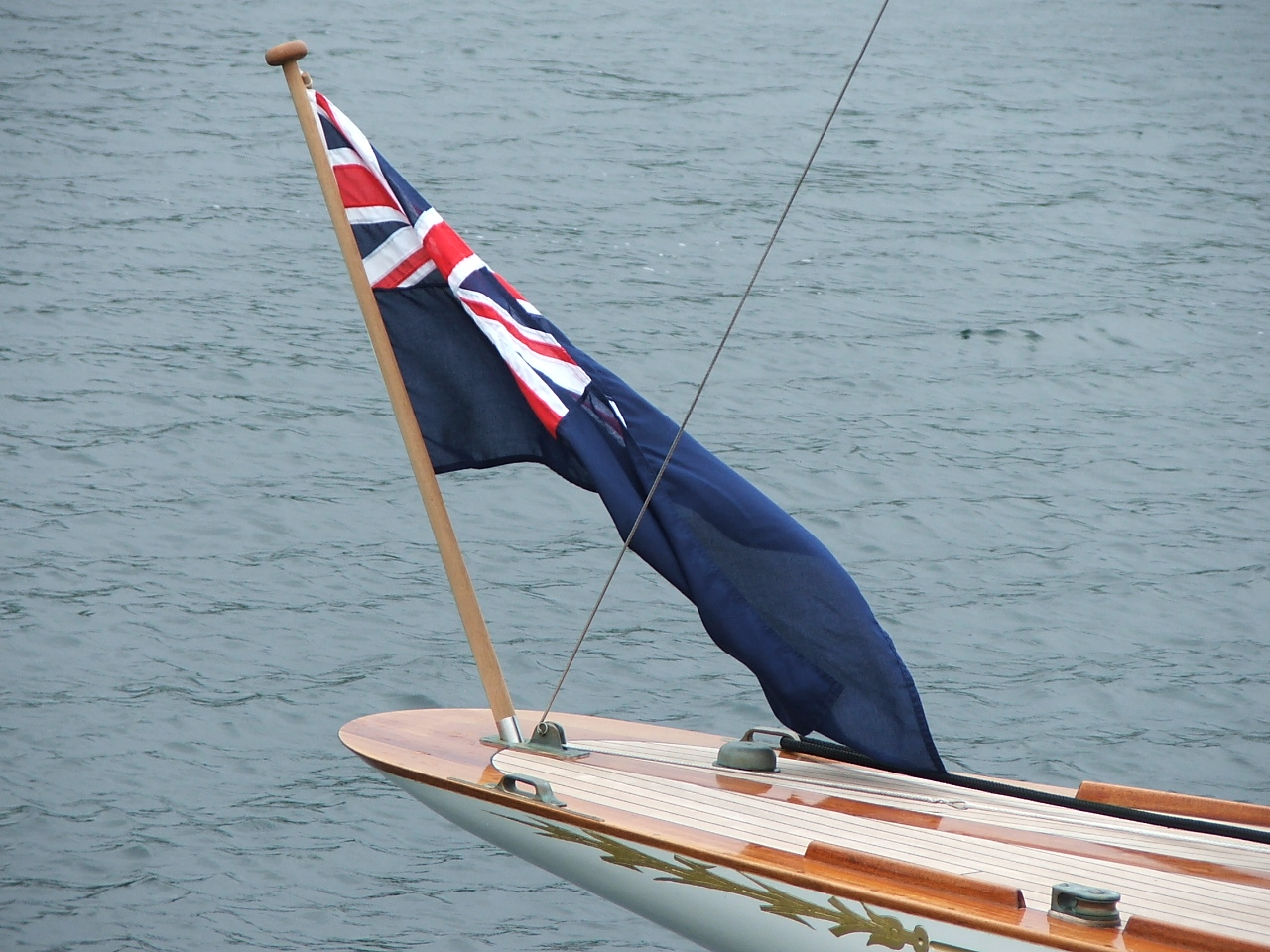
Day 2 started with wonderful sunshine beaming though the main hatch, to day was going to be a sail around the isle of Bute and on to Loch Ranza...what no one knew where the special surprises that lay in store along the way..
Firebird and Swift where the first yachts to clear the marina and ambled out to clear water to hoist thier sails, the remainder of the flotilla slowly slipped there lines and joined in the procession up the channel around the Isle's of Bute.
The Fife yachts had been moored in Rothesay just south of us. As we started our tacking course we could see the old yachts starting to gain on us. It was not long before "Swift" and our yacht "FireBird" , where in the thick of the Fife Yachts. it seemed that every tine we tacked we had another old yacht on our quarter or looking to exercise it's starboard right of way. It made for some very interesting sailing. All this excitement and the area we where sailing inn was spectacular, the sun even shone on us for most of the day.

As things progressed in the evening locals chatted with sailors, and it was not long before a little live entertainmant was conjured up. Skipper Richard Byrnes plays in a Celtic band on his USN base in Naples, at the pub he found a guitar and played afew songs solo.It was not long before a local couple joined in with thier talents... a celtic fiddle, a penny whistle and some spoons, along with Richards guitar had alll the pub patrons dancing and tapping with thier feet.
The evening drew to a close and by midnight everyone was headed back to there yachts.. It had been a magical day, from the outset, starting with glorious sunshine, sailing with the Fife Yachts around the Isles of Bute, arriving in Loch Ranza and going to a whisky distillery and then finally getting involved with the locals in a Celtic musical Jam . Great way to end the second day here in Scotland, Tomorrow is another day and the prospect of seeing Tarbert is exciting.

Day 3
I woke to the sound of a howling wind, the boat was swinging and tugging at her mooring lines. It sounded like a thousand ants where marching on the deck, thankfully it was just hard rainthat was pounding the deck..... Good Morning and welcome to Loch Ranza mooring field. Our little fleet of ASA yachts are all tied nicely in a line in the visitors area... The weather outside suck's!!!!.... so this is Scotland in summer....hmmm... remind me next time to read the brochure more closely.... Skippers meeting at 0930....
Well the weather is not about to improve, the pluses are ... with this wind its a down wind sleigh ride to Tarbert, the village is only 18 miles away and we have a nice marina with facilities to use after what will be a wet ride there.
General consensus was to use just the Foresail to get there as wind speeds had already hit 28knts in the bay and would undoubtedly hit 30 +...
Our intrepid sailors set off one at a time all dressed in full foul weather gear and safety harness visible. It really was not until we had cleared the lee of the island did we start to feel the full force of the winds and see the size of the waves.... these seemed more than normal and often would contribute to an occasional round out.

The trip to Tarbert was quick thank fully, the wind made for high overall boat speeds, which soon brought us to the entrance. The harbour is tucked way inland behind rocks and several significant navigation obstacles. We found the entrance and followed a fishing vessel into the harbour to be sure .
The village is predominantly a commerical fishing harbour, with most of the catch going to Glasgow.... some of the local restaurants also buy from the fisherman.
Returning back to the pub it was evident that the local talent was going to have another sing along in pubs along the is harbour.
These sailors retired back to their yacht as it was time to take stock and prepare for the sail down to Campbelltown over 35 miles to run...
DAY 4
Rain and more rain, drizzle the worse kind of rain as it just hangs in the sir for you to sail into and get wet, it gets behind the glasses you wear, trickles down your neck....finds it's way up your selves and just makes things wet, cold and miserable... Oh why do we do this to our selves ? In search of what ?....what is worse is that you have half the visibility and can not see much, not even the wonderful landscape that you know is there, expect its blocked by the drizzle of the rain.... thats how we left Tarbert.....

However, if you wait 5 minutes the weather may change for the better.... and guess what it did, the further away we sailed from Tarbert the clearer and better it got... and yes there it was a funny looking yellow thing bright and warmth coming from it.... 'here comes the sun'...(thank you George for that song) now I can really sing it with meaning...
Things where looking up, the drizzle had faded away, we had a delightful westerly breeze the boat was making way to Campbelltown, the kettle was on the boil and a hot mug of tea was on the way up to the helmsman... was this what I have been searching for ? may be....
It was going to be a long day, nothing complicated just pure sailing in what was shaping up to be great conditions... Flat to moderate seas, a steady 15-19 knots on the beam and yes the sun... peeking in and out from behind white cotton balls of clouds.
The landscape of Isle of Arran is spectacular, green fields, steep hills rising into small mountains, it looks as if someone has painted the landscape with shades of green and brown and golden yellow. The effect is to make look like a continual painting as you sail by....
We where half way down to Campbelltown and the day was turning into one of those that you want to keep going for ever.... What a start we had.... now it was all so far gone and forgotten... ahead was a new port new friends and new adventures... Campbelltown here we come....


\
Day 5
After a days sailing yesterday that ended with spectacular scenery, as we sailed into Campbelltown, and to be meet by a seal who guided the yachts into thier berths at the floating dock... the Skippers decided on a day to explore the town, and experience a little island life. Crews went in different directions quite a few headed for the various trails to be explored in the area, including the walk over to the light house island once the tide had gone down.

Others went trekking around town exploring the shops and the local distillery at Spring single malt. Torridon's skipper went in search of Bag pipes and found a local Fish and Chip shop who's young son came down and played a medley of tunes for the assorted group. Later the local bagpipe school sent 2 other pipers to play in public outside the local town monument.. it was a moving experience to hear the bag pipes played so well.
The rest day was well timed as the weather for the last day was going to be perfect. a southerly and sun was promised..
Home ward bound.....
It was an early start,0830 we slipped lines at the dock and cleared the sea bouy an hour later. We had 42 miles to sail, with a predicted southerly to arrive. At the moment we where sailing nicely along with a west South west, skirting the southern part of the Isle of Arran before we headed north and set our sights on Larrgs and home port.


The day developed into the best days run with warm sun heating up the cockpit, Crews where even seen to take off foul weather jackets and pants....now that was a first for the week... the flotilla arrived back in Larrgs by 4pm that afternoon, and it was a matter of gathering the yachts together on the pontoons and handing them back to the agent. That evening we all gathered at the local pub and had our last evening dinner together. Good byes where said and cries of lets do it again next year ......
SO SHALL WE DO IT AGAIN NEXT YEAR...... LET US KNOW HERE....




CHARTER A YACHT IN GREECE
WWW.SAILCHARTER-GREECE.COM
Subscribe to:
Comments (Atom)