Showing posts with label yacht charter greece. Show all posts

Friday, February 7, 2014

STORM TACTICS AND WHAT IT MEANS TO A SALTY OLD BN....

I’m 57 years old, and have been sailing for most of my life, Royal navy, Ocean racing, 4 times across the Atlantic under sail, 2 times across the Pacific and once down south as far as 56 degrees south. I've only been scared at sea four times. By scared, I mean worried that I wouldn't see dawn. Three of those episodes involved major gales with opposing ocean currents. The fourth was a different combo — a major storm combined with a jammed sail. We made it through that last one, but it was stressful.
I've been miserable for week-long stretches.
This isn't to say I haven’t been worried or uncomfortable at other times. I have been, truly. In fact, I've been miserable for week-long stretches. But misery is my middle name. Offshore sailors have to be stoic.Suffering is just part of the mix. I like to think of the experience as an organic social strainer that naturally weeds out the bozos, landlubbers, and dirt dwellers who are better off hugging a rock.
The reasons I am not scared offshore are many.  One of the chief reasons is that I’m not scared of death. I fear dying in some uncomfortable, prolonged way, true. But everyone dies. It’s part of life. Change is our only constant, and death is the ultimate change. I view death as really just a scheduling conflict: you might want to croak off on a Saturday so you get one more Friday night beer-blast in, but God might send you off on a Wednesday morning. There’s no shame in death; only in not living while alive.
If I knew that sailing offshore would kill me, would I continue?
My life’s goal is freedom. My boat is the ultimate tool to achieving that lofty goal. On the outset of my first circumnavigation, on the lip of the Eastern Pacific, I thought about the 3,200 miles of empty ocean before me. I asked myself: If I knew that sailing offshore would kill me, would I continue? My answer surprised me. It was an unqualified “Yes!”
The life I lead is so intoxicating and riveting and free and fulfilling that I’d gladly sacrifice all my tomorrows for another one or two minutes of today. I’m in the moment, and it is a very, very nice moment.
I do not ‘hope for the best’ and pray I’ll be okay. Instead, I prepare for the worst.
If sin exists, this is it. But the ‘death thingy’ is only a small part of my offshore philosophy. I’m seldom scared at sea because I work hard to be prepared to survive the conditions I’ll encounter. Most disastrous voyages begin at the dock with a lack of foresight and preparation. I do not ‘hope for the best’ and pray I’ll be okay. Instead, I prepare for the worst. This gives me a level of self-confidence and serenity that others may lack.
Let’s take a peek at anchoring, for instance. Anchoring is the bedrock skill of the coastal sailor. I have over $10,000 invested in having my anchor hold. Many people find this amount excessive, while I, frankly, find it paltry. I spend the vast majority of my cruising life “on-the-hook.” What’s more important than having my anchor hold to a person such as myself?  That’s why I have five anchors, a 250-foot chain rode, four 200-foot Nylon rodes, an anchor windlass, and various other bits to ensure my vessel stays put. The concept is simple: I should be able to safely and dependably anchor my vessel at will, given a decent bottom (sand or mud) and appropriate depth. If any vessel can hold, I should be able to hold. Thus, I mouse my shackles, rig my chafe gear, and juggle my chain claws with a clear and definable goal — to maintain position while others drag.
Shore is the danger, not the open sea.
Yes, I have three different anchor snubbers aboard. Yes, all this gear costs money and takes up space. But that’s is the price of admission in Minerva Reef, Beveridge Reef, and Chagos, locations where we regularly anchor in horrible weather conditions for months at a time. The other reason I’m not worried at sea is because I’m away from shore. Shore is the danger, not the open sea. I like to think I’m always the first sailor to leave an exposed anchorage before it turns into a lee shore. I’m proactive. I crank up. I move. My job is easier offshore. While sailing in deep ocean, I have many options as a storm approaches. First and foremost, I reduce sail. This is the primary difference between an inshore sailor and an offshore veteran — the seasoned veteran always has the correct amount of canvas up. (Yes, we still say canvas in this Age of Dacron.)
My current vessel, a sturdy 57 foot  ketch, is a delight in a blow.  As the wind increases, I roll up the genoa while unrolling the storm staysail. Then, as the it increases more, I tuck in a single reef, a double reef, and finally I douse my mainsail, hoisting my storm trysail.
Usually, it isn’t the storm gear that saves a vessel from floundering. It’s the experience of her crew.
With my flat-cut storm staysail, my tiny storm trysail, and a double-reefed mizzen, I can (semi)comfortably and safely sail to windward in 40+ knots. If my course is off the wind and my vessel is experiencing any tendency to round up or brooch, I trail a little something astern. This can be as simple as two fenders on 75 feet of line, or a small ‘gale-rider’ drogue. Anything that creates a mild turbulence will do, and the effect is often dramatic and immediate. A vessel that is wallowing and fighting its helm instantly becomes manageable upon launch of the fenders.
There are times, of course, when the sea and wind builds to such a crescendo that all forward movement is inadvisable. In these conditions, I heave-to.
I’ve never seen God’s face, but the closest I’ve come is aboard a small boat in a large ocean, pirouetting atop a giant wave.
Heaving-to is easy and fast. You merely allow a tiny amount of sail to remain up to steady your vessel’s roll and to keep her positioned approximately 45 degrees off the wind. This usually means I have the extremely rugged storm trysail up —  with perhaps a double or triple reefed mizzen — and my helm hard over. Helm hard over? Yes. I leave the helm hard over as if to come about. Since the boat isn’t moving there is no water flow past the rudder, so the rudder doesn’t work and the boat doesn’t come about. But it tries to, and stalls out on repeat. The boat gets a little forward speed, the rudder kicks in — and kills that speed.
If at first she hunts, I micro-adjust my mainsheet, traveler, vang, and helm until she is almost dead in the water. She will sit there for days (I’ve hove-to for 72 hours plus, at times) as pretty as you please. This has worked for 90% of the gales I’ve encountered on my circumnavigations. If you perfect heaving-to to the ultimate degree, your vessel will have zero speed forward and be pushed directly downwind sideways with your keel making considerable turbulence in the water.
This resulting ‘slick’ to windward serves to trip/trick the waves into breaking before they reach you. I’ve made it through major gales with patches of dry deck showing amid huge breakers, all because of this ‘slick’ effect. Remember — losing all forward motion isn’t easy nor quick to accomplish, but it’s well worth the effort. As a test, drop a wet paper towel into the sea to windward. If it appears to be magically sucked up directly to weather, that’s perfect, because it means the boat is drifting directly downwind!
Another option is to ‘run off’ before the wind and breaking seas.
This can be done if
  1. the gale isn’t too severe;
  2. you have plenty of sea room, and;
  3. you’ll be heading fast in the direction you desire.
One advantage of this method is that it presents your highly buoyant transom to the waves. The downside of this method is that, as the wind and waves increase, your vessel starts sliding down the face of such large seas so fast that her rudder aerates. She can spin out (broach) or tumble end-for-end (pitch-pole) during such conditions. Pitch-poling is nearly always catastrophic to the vessel, and often fatal to the crew. This is where a Jordan Series Drogue is worth its weight in gold. This is basically a long rode (line, Nylon) with (in the case of our 43-foot ketch) 136 small cones or drogues attached.
The advantage is that the series drogue isn’t in one wave while the boat is experiencing a different wave (and the horrible resulting shock load), but rather it is immersed in many waves. Thus, there’s little shock loading (except when a large sea breaks aboard) and the Series Drogue suffers almost no damage even in prolonged hurricanes.
Of course, the boat is oriented transom-to the waves. This makes the rudder vulnerable. So it must be secured amidships. The plus side of this is that 99% of sailboats want to drift nose down, so it is easier to keep them in this attitude than to maintain a ‘head up’ position to the wind and waves. If I don’t want to offer my transom to the waves, I deploy my Paratech sea anchor on 250 feet of stretchy Nylon attached via a shackle to 250 feet of heavy chain. I’m careful to make sure that we’re crest-to-crest. This means that the boat and the parachute anchor crest on the waves at precisely the same moment about 400 to 450 feet apart. This is important. If the boat crests a wave while the parachute is in the trough, they are suddenly 40 to 60 feet different, and the resulting shock load can snap lines, rip off chocks, and decapitate the main bitts.  All these tried-and-true options, once mastered, take the sting out of storm strutting. Now, in many ways, I look forward to an approaching gale. I call them to me — not in challenge, but in acknowledgment of their power and beauty and majesty.
I’ve never seen God’s face, but the closest I’ve come is aboard a small boat in a large ocean, pirouetting atop a giant wave.

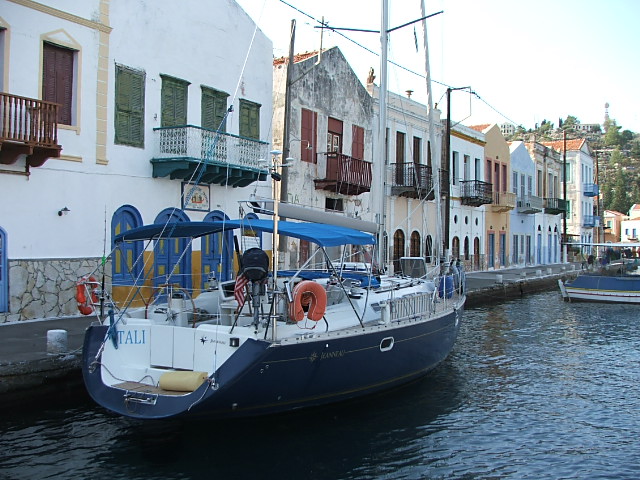
Wednesday, November 21, 2012

ATHENS - TEL AVIV OFFSHORE TRAINING


The delivery and advanced ocean passage that the school has just finished has been an interesting experience in different sailing philosophies and safety at sea. The 
school in an attempt to broaden its winter income base, has expanded into the yacht restoration business. We maintain a winter maintenance crew that service our 
school yachts and also do a certain amount of freelance work. The current Greek crisis has meant the decline in school business has required we diversify into more broad 
yacht services. Using our highly skilled winter staff to do yacht restoration was a logical step.
Our first client has been an Old school student that bought a used charter yacht and then requested that we renovate it back to its original condition. This included new teak decks, new standing rigging, upgrading of deck gear and replacement of all running rigging. We also installed a fully comprehensive navigation package from Raymarine, that included their new radar/AIS/plotter interfaced computer screen, with all yacht instruments and the auto pilot. A truly one button navigation system. The system is also very addictive, and in my opinion will create some very bad habits, more about this later.
The owner of the yacht required that we deliver the yacht back to Israel once all work was completed. He was going to accompany the delivery crew with his 90 year old father. The crew was to be 6 but was shortened to 5 when a crew decided that the current situation in Tel Aviv made them uncomfortable. Our first leg was to be Athens to the island of Kos, where the yacht would refuel and then continue on to the remote island of Kastellorizo. Here the yacht and crew would check out of the EU and then continue out into international waters.

The trip started with a short shakedown sail to Poros island. It was a good chance to check out the new Raymarine toys and to do a more detailed tuning of the mast 
and new standing rigging. It was a good 5 hour sail in about 15-20 knts of breeze that came pretty much from all directions.

The following day was a hive of last minute adjustments, both to the rig and to the safety equipment. The yacht left late that afternoon heading out for the Cyclades 
island group and the further island of Kos. As the owner of the yacht was on board, he assumed the role of Captain with my self being more of an advisory role. The other crew members already had there  ASA and RYA licenses, so this was more a mile building exercise as well as offshore experience for them. The first night of any offshore sail is always one that has  sailors getting use to watch systems again as well as finding their sea legs. So a little irregular behaviour needs understanding and flexibility. I have always found that a good evening meal on the first night if possible goes along way to ensuring confidence and comfort for the coming nights watch.
When quizzed about watch our captain was fairly non-committal about what he wanted and said that it was better if everyone did what they felt like. He further went on 
to mention that food was not a priority with him and that a little bread and cheese was all he needed.  At first I was very disappointed with his answers, he had been 
one of our first students to come though the school, he already had a huge back ground of sailing but no real paperwork when he joined the school course back in 
2005. Since then he had completed this very same 'run' Greek islands to Israel some 5 times with his and other yachts.. so he was well aware of the changing weather 
patterns and changing sea states that one can encounter...

We finally arranged ourselves into 3 watches, 2 hours on and 4 off with the owner and father doing their own thing.. the yacht was extremely comfortable with a huge 
cockpit and cockpit table in the middle, long side benches that you could lie out on, full dodger and Bimini, and all major control lines lead back to the cockpit 
coaming allowing for easy dry access to trim and control the sails. Unfortunately the cockpit was so well sheltered that keeping a 'good' watch out at night meant alot 
of craning your head and neck around lots of supports and fabric... which is when the huge computer screen mounted by the helm station became a much more 
easier and dryer way of keeping a watch out.


The trip to Kos is about 190 miles as the crow flies, we logged 230nm with a couple of tacks thrown in. As a result it took us over 38 hours. The latter half of the trip  was in heavy rain and limited visibility.  The Raymarine package with its Chartplotter and interfaced AIS+radar was a very nice toy to have, making identifying shipping  and other objects a simple matter. However what it did not see was more troublesome, the local Greek fishing fleet do not carry AIS.... nor do there fishing long line markers or drift nets... making the old skill of looking at the sea and horizon ie:- keeping a watch still the primary skill to learn..
Once in Kos it was a short stop over with the crew taking a break ashore and looking for some breakfast while the owner took charge of refuelling the yacht. Some 
supplies where purchased but as the crew had not eaten a "Galley cooked meal' since the first night and where self-feeding themselves, not much in the way of 
immediate supplies had been consumed. The yacht was soon under way again this leg was to take us along the Turkish coast, north past Rhodes island and then to 
parallel the coast until we arrived at Kastollrozio island.

That evening was a busy time on watch, identifying shipping coming out of Rhodes and other ships heading to Rhodes. The weather again deteriorated to rain and squall fronts rolling off the Turkish coast. The Rhodes channel can at times have a heavy wind driven surface current running east west; this particular night it was  running at least 2-3 knots which made our SOG as little as 3knts at times. This is not a good speed to be trying to avoid shipping traffic, despite the fact we where  motor sailing for most of the time. Again the Raymarine AIS/Plotter package proved its worth, however it was still imperative to keep a physical eyes out over the horizon  watch and not become glued to this very addictive screen like some video game.

The rest of that evening was a mixture of squalls and washing machine like seas that caused the yacht to pound and bounce around the sea slowly on its way to 
Kastellorizio island.  Up to this point the yacht had been steered almost exclusively by auto pilot, with neither the owner nor our crew steering by hand for more than 
30 minutes. I think I had the most time on the wheel with our 12 hours since leaving Athens.
The rest of this delivery continued with little change in the way things operated or the prevailing wind conditions as once the yacht left Kastellorizo for Tel Aviv, we had 
to face a remaining 350 nm of pretty much windless sea and intermittent rain. The extra jerry jugs of fuel we carried on deck proved necessary and the yacht finally 
made it to Tel Aviv.

Looking back at this particular trip, has brought up quite a few significant issues that where faced and perhaps not dealt with as well as could have been, for example the dependence on too  much modern technology. I am not some one who believes that the Old School Way is the only way, but a healthy mixture of both old and new can prove to benefit all concerned.  Before that is reached you have to start with a Captain that has an idea of what he wants and how to implement his desires and discipline on the crew, skilfully.  Having no plan or idea of what is required from the crew can be more damaging than having too much sometimes. The modern acceptance of just opting out or passing the buck I'm afraid does not cut it on a sailing yacht. Clear leadership is what was required, and having 2 captains on a yacht can complicate things. It was not my place to challenge the decisions made at the time.
However, my observations have lead me to believe that even though the advance of electronic navigation instruments is wonderful and extremely helpful, our addictive 
nature as humans makes us rely on them much to heavily, forgetting our old skills as seaman.
I really do not think it is a good thing to come on deck watch and check the computer screen first for traffic before you have scanned the horizon. I prefer to hand steer as much as is required rather than let a yacht be steered by auto pilot 100% of time come wind or sea state. Auto Pilots allow a yacht to pound and bounce into potholes. There will never be a replacement for hand steering or a good helmsman.
There has been alot of studies on watch systems, sleep patterns and nutrition at sea. Unless I am mistaken they have all basically come to the same conclusion,  regular watch/sleep rhythms and regular feeding time, make a happy and efficient crew. Arbitrarily sleeping and eating leads to fatigue and mistakes. My lesson from all this has been to emphasis more the interaction of modern and old ways but never ever to rely solely on modern technology.


Monday, January 23, 2012

TEAM NEW ZEALANDS ''RULES OF THE ROAD"'

Team New Zealand's Rules Of The Road

Racing, Miscellany, Team New Zealand

An excellent set of guidelines for conducting yourself  like a professional sailor.

Rule number 1

No phones at dinner. As soon as a phone comes out the offender is fined. Fines are immediate and can be paid at the bar. Sounds old school but it really bugs me to have a get together and someone is Skyping their sister, surfing the net, or on Facebook. It’s not right!

Special permission can be granted to have a phone on the table. I think we gave permission once in France.  At the time some questioned the wisdom of allowing any exception to the “rules are rules” policy, but Burg’s wife was in labour back in New Zealand.

Rule number 2

Change the shirt or change your beer.  It never fails to amaze me how many people just don’t get it. An example from the past: How can a team member wearing the Emirates Team New Zealand shirt, proudly displaying our sponsors, including Estrella Damm, order a competing beer?  In the bottle no less!  Imagine if a director of  Estrella Damm was socialising with his/her team and seen drinking a competitors’ product. Not a good look for anyone.

Rule number 3

While we are at it, clear away the empties. As the team has matured over the years I don’t have to use this line much. Picture this: You see yachties sitting, having a good time, perhaps a bit loud, at a table littered with empty beer bottles. Now picture the same scene but the only bottles in sight are those in use. A very different perception of the same situation. Better yet, no bottles and the beer is in a glass. All Black management discovered long ago that people tended to drink less if they drink from a glass.

Rule number 4

No job is too trivial.  Wash the sails, clean the container, take out the rubbish or get lunches; doesn’t matter if you the youngest or oldest, skipper or a rookie boat builder. No matter where you are in the pecking order, you do whatever needs to done. Just get on with it, no complaining. And no festering.  Festering is where you are hanging out just…….festering.  Not getting anything done. Everyone get the jobs done and leaves.

Rule number 5

Win, by all means but make it fun. Little things like dinner together, having a beer together after sailing regardless of the day’s results or just being happy. It’s contagious, if you’re upbeat and looking forward the others will fall in line. If you’re walking depression you will drag your comrades down with you.

Life is too short not to enjoy it.

Friday, January 6, 2012

SPRING CLASS SCHEDULE AND SUMMER RACE PROGRAM

SPRING 2012 CLASS SCHEDULE NOW AVAILABLE:
  • APRIL 7 - 16.... EASTER SAILING SCHOOL MILE-BUILDER 10 DAYS.. €1800 A PERSON

Yacht racing has for a long time been a sport that has challenged the masses. For many years it has been the sport of the rich and famous. However, to day it is possible to charter a fully equipped race yacht and go racing. That's assuming you know all about the racing rules and how to man oeuvre one of these complex machines.


So how about becoming part of a crew that races in the Aegean Summer series.

2 race series to choose from, 2 different island groups to visit


The ASA along with Athens Sailing Academy is offering the opportunity for sailors to participate in these prestigious events. The yacht you will Crew on is a 55ft performance Ketch designed by the French naval architect Guy Ribadeau-Dumas. KORALIA3 was built in the French yard of Jeanneau 1990. The yacht has the pedigree to be competitive on the race-course and is able to highlight well any sailor who wishes to see themselves in the winner’s circle. The Aegean Rally is a well-covered media event, both on television and on the radio.

There will be 20 crewing  places available for each event.  These are events are for people who enjoy or wish to experience offshore yacht racing, as crew you will sail between 300 - 400 miles. You will play a full part in sailing the yacht, including navigation, keeping watch, and taking a turn in the galley. You will have ASA Instructors on hand to help you should you require advice. Although aimed at the more experienced sailor, it is possible for members who have passed their ASA 101 to join these events.
 AEGEAN RALLY 49 2012  
JULY 14 - 23...... 2012
10 days racing price per person
WOR 60 per/p  €2000 
57ft ketch per/p €1800
Start in Athens Palio Faliron, racing to Crete the town of Chania then returning via the island of Milos and finishing in Athens
25 BERTHS AVAILABLE, CREW  TRAINING INCLUDED PRIOR TO RACING.
----------------------------------------------------------------------------------------


 AUGUST 18 - 26.. 2012
7 days racing price per person
WOR per/p €1800
57ft ketch per/p €1600
Start on the Island of Lesbos, race to the island of Chios. Third leg will be to race around Chios Island. Final leg will be to race to Syros island in the Cyclades.
25 BERTHS AVAILABLE, ALSO DELIVERY BERTHS, CREW TRAINING INCLUDED.


Saturday, October 16, 2010

KORALIA 3 , HAULED AND CRADLED..

Friday saw an early start as we had plans to get K3 to the 'haul out dock' by 0930hrs. Like all good things in greece plans get a little delayed and despite the fact we where on time... the crane operators and haul out crew where a little delayed.  So we adapted the classic  hurray up and wait mode... patience is something you learn quickly in greece... it was a pleasant morning the first real sunshine we have had all week after  all the clouds and rain that we have had this week. Stammas (the Crane operator) and the boys finally showed up and we where under way.. Crane fired up and lifting straps placed under the hull.. final check to make sure nothing was forgotten.. speed log pulled, all though hulls open.. ok lift away.... Out of the water she came, pretty clean on the hull too, a little green slime on the starboard boot striping, some fur slime starting to grow on the rudder, otherwise clean as a whistle... quick guys power clean her off and lets roll again for another season.... I think not !! In Alimos marina they pick yachts up with a 50 ton crane, transport them to a cradle on wheels and then drive them a short diatance to the yard where they pick the yacht up again and place it in the cradle for the winter... not the most efficient way of doing things but given that there is not a travel lift area and the confined space they have to work with... it all seems to work well. So whats next... K3 in her cradle for winter service and maintenance... we have to prepare the masts for withdrawl and inspection at the end of the month. Along with getting 'Calypso' out of the water as well, all that is scheduled for the end of the month. Meantime the skipper and crew will be taking a week or so off, well working at half speed any way... Here is a short video of the whole event...  enjoy.. more later..

Monday, October 11, 2010

40ft YACHT AVAILABLE FOR STUDENTS TO SAIL / CHARTER

Many of our students have asked us to help them find a charter yacht for them to use, once they passed thier Skippers exam. With so many 'Bare Boat' charter companies available it is difficult to recommend any one company.  It is also difficult to choose any one model of yacht.
The average sized yacht is around 40 ft and offers 2-3 sleeping cabins, from there your choices are pretty much endless.
We have choosen Jeanneau Yachts as our teaching yachts becasue of thier excellent construction and modern yacht design. They have a high attention to detail on interior construction and excellent deck layouts that make sailing easy and safe.
We can offer our students a 40ft Jeanneau Sun Fizz. The yacht has a 3 cabin layout, with 2 heads. The deck layout is traditional, with wheel steering, and a fully battened mainsail.


"Eleni" was built in 1992 and was the last of her series, she has been in private use for all her life and so is well maintained. The yacht has a 55hp Perkins engine, that offers good auxillary power, especailly when the wind dies off here in the Greek islands.

The school offers 'Elenei' on a daily/weekly charter option... 300 EURO a day...The rate does not include fuel, taxes, yacht expenses.


For bookings and further details please contact the school direct at
information@athenssailingacademy.com or call 00-30-693-716-3246


Saturday, September 11, 2010

MILE BUILDING CRUISE SPRING 2010

Athens SailingAcademy
This is a short photo description of our opening Sailing School Mile building cruise we had. It was in Late April and we sailed over to the western Cyclades, visiting, Kithonos, Siros, Paros, Siphonos, Serifos before coming back to the Saronic Gulf and a quick run over to Plaka and Spetsai before heading back to Athens......

On board was Aviv, and Dror from Isreal, Mike and Janet from Uk, and Capt.JC.
Without knowing it we somehow managed to log over 400 miles in 10 days, and quite a few night hours as well.


So enjoy the pictures, more to come from our "Around the Peloponnese Cruise" and lots of Video still to load...
All the Best
A.S.A

Thursday, August 26, 2010

Hello to Everyone

Hello

Welcome to The Athens Sailing Academy Blog... We finally have found time to put one together. Here you will find information about what we are up too.. Who's passed thier ASA Licenses.. and become a Bare Boat charter skipper...

What classes we have going on and when, what Mile builders are scheduled and where they plan to go...


What regatta's are we planning on competeing in and how you can join in and expereince real offshore racing.


There will be lots of pictures, video's, comments from crew and students, as well as instructional sailing tips and much more...


So as they say "watch this space' and stay up to date with the latest happening at Athens Sailing Academy... we look forward to having you sail with us

How to use winch